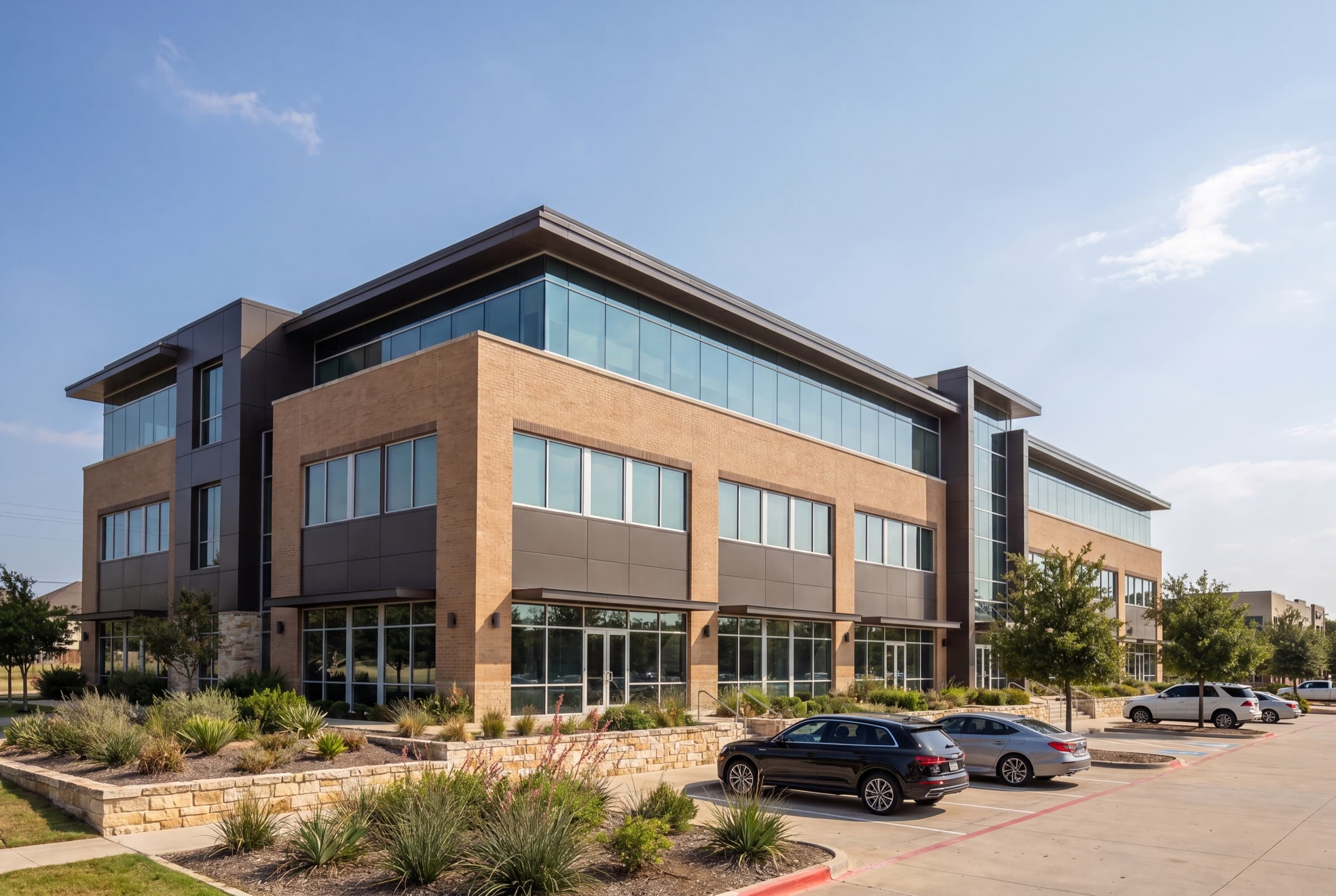
Commercial Real Estate Loans in Texas
Commercial real estate loans are structured around the income a property produces, not just the borrower's personal tax returns. Whether you are acquiring a five-unit apartment building in San Antonio, refinancing an office building in the Dallas-Fort Worth metroplex, or placing a note on a retail strip center in the Houston suburbs, the lender's primary question is whether the property's net operating income supports the debt. That shift in underwriting logic opens doors for investors and business owners who own strong assets and want to grow a portfolio without being constrained by personal income limits.
Apex Capital Mortgage works with a network of commercial lenders, community banks, credit unions, and private capital sources to source financing for a wide range of income-producing property types across Texas. Terms, leverage, and structure vary considerably depending on property type, location, occupancy, and borrower experience. What stays consistent is straight, honest guidance on what a deal qualifies for and what it will take to get to the closing table.
Is a Commercial loan right for you?
- Investors acquiring or refinancing multifamily properties of five or more units in Texas markets such as Austin, Houston, or San Antonio where rental demand remains strong.
- Owners of office, retail, mixed-use, or industrial property who need a loan underwritten primarily on the property's debt-service coverage rather than personal income.
- Experienced real estate operators looking to pull equity out of a stabilized commercial asset through a cash-out refinance to fund their next acquisition.
- Business owners purchasing the building their company occupies, where the deal is structured as a business-purpose commercial real estate loan rather than a consumer mortgage.
How Commercial loans work in Texas
Texas is one of the most active commercial real estate markets in the country, and that activity is spread across multiple major metros rather than concentrated in one city. Dallas-Fort Worth has seen sustained demand for industrial, multifamily, and mixed-use product driven by corporate relocations and population growth. Houston's energy-sector economy supports a deep office and industrial market alongside one of the most active apartment markets in Texas. Austin's growth has pushed multifamily valuations sharply higher and created demand for retail and mixed-use product in surrounding Hill Country communities like Boerne and New Braunfels.
Texas's lack of a state income tax and its relatively business-friendly regulatory environment have drawn both domestic and out-of-state investors, which has helped keep transaction volume high even during periods of rising interest rates nationally. For borrowers, that means lenders active in Texas are experienced with the local market and generally comfortable underwriting deals across property types and geographies, from urban core assets in San Antonio's Pearl District to light-industrial parks on the outskirts of the Houston metro.
Commercial loan structures in Texas follow national norms, with a few important local considerations. Texas is a non-judicial foreclosure state, so most commercial deeds of trust include a power-of-sale provision that lets a lender foreclose relatively quickly, outside of court, if a loan defaults. Because these are business-purpose loans, they sit outside the consumer-mortgage protections that apply to a primary residence, and the homestead protections built into Texas law for owner-occupied homes do not extend to income-producing commercial collateral. It is worth confirming early whether your deal is recourse or non-recourse and how the guaranty provisions are written. Apex Capital Mortgage's lending partners are experienced with Texas-specific documentation and can walk you through those details before you are under contract.
Appraisal and environmental requirements on Texas commercial properties can add time and cost to a transaction compared with residential deals. Most commercial lenders require a Phase I environmental site assessment and a full commercial appraisal, both of which take time to order and complete. Planning for those timelines at the outset, rather than after signing a purchase contract, puts you in a stronger position to close on schedule.
This program may be available in the 22 states where our broker is licensed. Availability varies by property, borrower, and program requirements.
Review licensed statesWhat the Commercial program includes
- Eligible property types: multifamily (5+ units), office, retail, mixed-use, industrial
- Underwriting based primarily on net operating income and DSCR
- Loan-to-value ratios typically in the range of 65% to 80%
- Down payment commonly 20% to 35% depending on property type and lender
- Both recourse and non-recourse structures available through lending partners
- Balloon terms with longer amortization schedules are common
- Financing available across DFW, Houston, Austin, San Antonio, and beyond
- Cash-out refinance available on stabilized income-producing properties
General parameters
These figures are illustrative starting points. Your actual loan terms depend on your credit profile, income, assets, property, and current market conditions.
- Loan-to-value
- Typically 65% to 80%, varies by property type, occupancy, and lender (illustrative)
- Down payment
- Often 20% to 35% of the purchase price for most commercial property types (illustrative)
- Loan term
- Commonly 5, 7, or 10 years, with amortization over 20 to 30 years and a balloon at term end (illustrative)
- Debt-service coverage ratio
- Most lenders look for a DSCR of at least 1.20x to 1.25x, meaning NOI covers the debt payment with a cushion (illustrative)
- Amortization
- Typically 20 to 30 years; shorter remaining amortization is common on refinances of older loans (illustrative)
Mortgage services are offered through Directions Equity LLC d/b/a REV Mortgage (Company NMLS #214519; San Antonio Branch NMLS #2583932). Apex Capital Mortgage supports Equal Housing Opportunity. This is not a commitment to lend. All loans are subject to credit approval, income and asset verification, and property appraisal. Rates, terms, and programs are subject to change without notice and may vary by borrower and property. Not all applicants will qualify. Information on this site is for general educational purposes and does not constitute financial or legal advice.
Commercial loan questions
- How is a commercial loan different from a residential investment property loan?
- The biggest difference is how the lender qualifies the deal. Residential investment property loans, even on a fourplex, rely heavily on the borrower's personal income, credit, and debt-to-income ratio. Commercial loans, covering properties with five or more units and most non-residential asset types, are underwritten primarily on the property's net operating income and its ability to cover the debt service. Your personal financial strength still matters, particularly for recourse loans, but the property's cash flow is the lead qualifier.
- What does DSCR mean and why does it matter for my commercial loan in Texas?
- DSCR stands for debt-service coverage ratio. It is calculated by dividing the property's net operating income by the annual loan payment. A DSCR of 1.25x means the property generates $1.25 in net operating income for every $1.00 of debt service, leaving a 25-cent cushion above the payment. Most Texas commercial lenders target a minimum DSCR somewhere in the range of 1.20x to 1.25x, though the threshold varies by property type and lender. A deal that pencils below that ratio will generally require a larger down payment, a lower loan amount, or both.
- Can I use a commercial loan to buy an apartment building in Texas?
- Yes, if the property has five or more units. Properties with one to four units are typically financed through residential channels, including conventional and investment-property programs such as DSCR loans. At five units and above, a property is classified as commercial multifamily, and lenders underwrite it on the building's rent rolls and operating expenses rather than purely on your personal income. Texas markets like Houston, San Antonio, and Austin have deep multifamily liquidity, and Apex Capital Mortgage works with lenders who are active in both small-balance and larger commercial multifamily transactions.
- What documents will I need to apply for a commercial real estate loan?
- The package is more involved than a residential loan. You can expect to provide two to three years of property operating statements or rent rolls for an acquisition, plus personal financial statements and tax returns for the guarantors. Lenders will also want a rent roll current within the last 30 to 60 days, a purchase contract or current appraisal, and details on any existing debt being paid off. For a refinance of a property you already own, year-to-date financials showing current income and expenses are typically required. The specific requirements vary by lender and loan size, and Apex Capital Mortgage will give you a clear checklist at the start of the process.
Ready to move forward?
Tell us about your situation and we will walk you through the numbers. No obligation, no jargon.
Ready to see your rate?
Get a real pre-approval conversation with a mortgage professional who picks up the phone. Availability varies by state, program, property, and borrower qualifications.